



Read Next

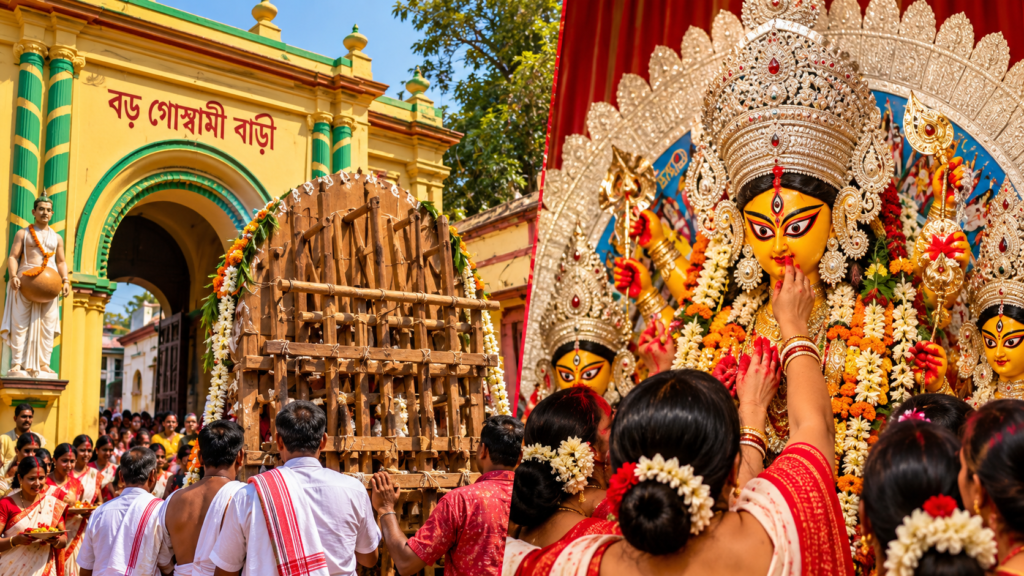
In the historic town of Shantipur in West Bengal’s Nadia district, Vijaya Dashami carries a significance that extends beyond the farewell to Goddess Durga. At the centuries-old Baro Goswami Bari, the immersion of Goddess Katyayani marks the conclusion of an important family ritual while also bringing renewed attention to preparations for the region’s celebrated Ras festival.
The religious practices of this traditional Vaishnav family have been preserved for approximately 350 years, making its annual Katyayani worship one of the distinctive heritage celebrations of Nadia.
The occasion brings together family customs, devotional practices and the cultural identity of a town deeply associated with the worship of Lord Krishna.
A Farewell That Signals Another Celebration
At Baro Goswami Bari, the conclusion of Durga Puja follows a sequence of traditional ceremonies observed across generations.
On Vijaya Dashami, the family begins the morning with prayers and rituals dedicated to Goddess Katyayani.
Women of the household participate in customary celebrations, including sindoor khela, before preparations begin for the immersion of the idol.
Unlike many other Durga Puja celebrations, the family’s Dashami observances also include a ritual connected to the upcoming Ras festivities.
A ceremonial pole is traditionally installed to signal the beginning of preparations for the festival.
The custom reflects the close relationship between two major religious celebrations in Shantipur’s cultural calendar.
The Legend Behind Katyayani Worship
The origins of the family’s Katyayani Puja are linked to an unusual account preserved through generations.
According to the Goswami family’s traditional narrative, an ancient idol of Lord Krishna, worshipped as Dolgovinda and associated with Sri Sri Radharaman Jiu, once disappeared from the family temple.
The disappearance caused great distress among members of the household.
Seeking divine intervention, the women of the family began observing a special vow dedicated to Goddess Katyayani.
Family tradition holds that the missing idol was eventually recovered from a pond near Dighnagar, not far from Shantipur.
The recovery came to be associated with the family’s prayers to the goddess.
In remembrance of that event, worship of Goddess Katyayani became an enduring annual observance at Baro Goswami Bari.
Although the story forms part of the family’s religious heritage rather than independently established historical evidence, it remains central to understanding the significance of the festival.
A Unique Form of Durga Worship
The Goswami family’s religious identity is firmly rooted in the Vaishnav tradition.
Consequently, its annual worship of Goddess Katyayani follows practices that differ from those commonly associated with community Durga Puja celebrations.
One of the most visible differences is the appearance of the goddess.
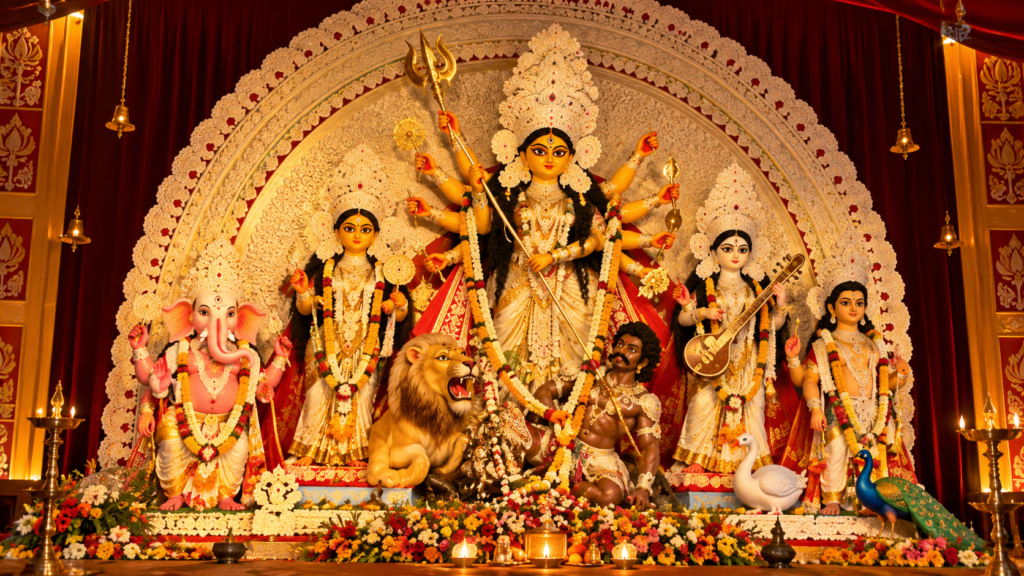
The idol has ten arms, but most are not depicted holding the conventional weapons commonly seen in Durga imagery.
The positions of Kartik and Ganesh also differ from those in many traditional Bengali Durga idols.
These features distinguish the family’s worship from other long-established celebrations across West Bengal.
The ceremonies are accompanied by customary offerings and specific rituals inherited from previous generations.
Why the Kitchen Remains Closed Until Immersion
One of the most remarkable aspects of the family’s Vijaya Dashami observance concerns the preparation of food for its presiding deity, Sri Sri Radharaman Jiu.
According to the customary practice, cooking for the deity’s bhog does not begin until the immersion of Goddess Katyayani has been completed.
As a result, the immersion ceremony holds particular importance in the day’s religious schedule.
The morning rituals are completed before the idol is taken for immersion, after which the preparation of offerings for Radharaman Jiu can begin.
For the Goswami family, this practice represents continuity with a religious tradition maintained by generations of ancestors.
The custom also demonstrates how distinct forms of worship coexist within the family’s Vaishnav spiritual heritage.
Shantipur’s Historic Connection With Ras Yatra
Shantipur is widely recognised for its handloom industry, historic temples and distinctive Ras festival.
The town’s Ras celebrations are associated with the devotional traditions surrounding Lord Krishna and Radha.
Among Shantipur’s religious institutions, Baro Goswami Bari occupies a prominent place because of its association with Sri Sri Radharaman Jiu.
The family’s religious calendar includes Ras celebrations, during which the deity is adorned in ceremonial attire.
One of the principal attractions is the Bhanga Ras procession, a traditional public celebration accompanied by devotional activities and the movement of decorated deities through the town.
The festival is an important expression of the region’s Vaishnav cultural identity.
Although the ceremonial preparations are connected with the conclusion of Durga Puja, the main Ras Yatra celebrations take place later, around Kartik Purnima.
For 2026, Shantipur and Nabadwip’s Ras Utsav is scheduled for November 24–27.
Preserving a Living Family Heritage
Baro Goswami Bari is more than an old religious residence. Its traditions offer a valuable glimpse into the historical development of Vaishnav culture in Bengal.
The household’s association with Radharaman Jiu and the continuation of Katyayani worship demonstrate how family beliefs can shape enduring community customs.
Women have played an important role in preserving these practices, particularly through the preparation of worship ceremonies and the observance of inherited religious traditions.
The annual festival also draws attention to the importance of maintaining local cultural heritage in an era when many traditional customs are changing.
For younger generations, these celebrations provide an opportunity to understand the beliefs, practices and stories that have shaped their family’s identity.
Where One Festival Ends, Another Begins
The conclusion of Durga Puja often brings a sense of sadness as devotees bid farewell to the goddess.
At Shantipur’s Baro Goswami Bari, however, that farewell is closely accompanied by anticipation.
The immersion of Goddess Katyayani completes an important chapter in the family’s religious calendar, while preparations for Ras Utsav turn attention towards the next major celebration.
The continuity of these rituals illustrates how Bengal’s religious festivals are linked through history, family traditions and community participation.
For Shantipur, the end of Durga Puja is therefore not simply the conclusion of a festival season. It is also an important moment in the town’s continuing journey through its centuries-old cultural traditions.

Trending Now
You May Also Like
Leave a Reply
Your email address will not be published. Required fields are marked *


Sharp daily reads on culture, style, wellness, travel, and the stories shaping modern life.
Recent Posts
Popular Posts